By Gerrit Ockerse, District Grand Membership Officer
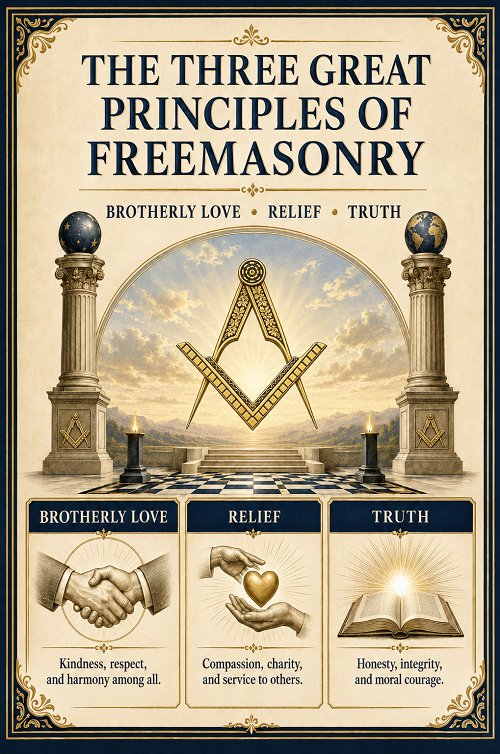
The Three Great Principles of Freemasonry are Brotherly Love, Relief, and Truth. These principles form the moral foundation of the Craft and guide how a Mason should conduct himself inside the Lodge, at home, at work, and in the wider community.
Freemasonry teaches through ceremony, symbol, allegory, and tradition. However, the value of those teachings is found in how a Mason applies them in daily life.
Therefore, the Three Great Principles of Freemasonry are not merely words to be repeated. They are virtues to be practised. They remind every Brother that Freemasonry is not only an organisation he joins, but a way of life he should strive to live.
The Three Great Principles of Freemasonry Explained
The Three Great Principles of Freemasonry give every Mason a simple but powerful guide for moral conduct.
Brotherly Love teaches kindness, respect, patience, and goodwill.
Relief teaches compassion, charity, support, and practical service.
Truth teaches honesty, integrity, self-knowledge, and faithfulness to duty.
Together, these principles help shape a Mason’s character. They encourage him to become more thoughtful, more useful, and more upright in his dealings with others.
In this way, the Three Great Principles are not separate ideas. Rather, they work together to form the heart of Masonic life.
Brotherly Love
The first great principle is Brotherly Love.
Brotherly Love teaches a Mason to regard others with kindness, respect, and goodwill. In the Lodge, men from different backgrounds, professions, cultures, and beliefs meet on common ground as equals.
This is one of the great strengths of Freemasonry. It allows Brethren to set aside division and meet in friendship, harmony, and mutual respect.
However, Brotherly Love does not mean that every Brother must agree on every subject. Rather, it teaches us to value one another despite our differences.
For this reason, a Mason should be patient, understanding, and forgiving. He should seek the good in others and extend the hand of friendship whenever possible.
Brotherly Love in Daily Life
Brotherly Love should not remain inside the Lodge room. It should influence the way a Mason treats his family, friends, colleagues, neighbours, and strangers.
In a world where division and conflict are often common, Brotherly Love remains deeply relevant. A Mason should build bridges instead of walls. He should unite rather than divide.
Moreover, he should treat every person with dignity and courtesy.
The true measure of Brotherly Love is not found only in kind words. It is shown through action.
A Brother practises Brotherly Love when he supports another during difficult times, encourages someone who is struggling, and offers sincere friendship to those in need.
Relief
The second great principle is Relief.
Relief is often connected with charity, and rightly so. Freemasonry has a long tradition of helping those in need.
However, Relief is not limited to financial assistance. It also includes compassion, support, encouragement, and personal service.
Sometimes a Brother may need help because of illness, loneliness, grief, or personal difficulty. In such moments, a visit, a phone call, or a simple message of encouragement may mean more than money.
Therefore, Relief reminds every Mason to be attentive to the needs of others and ready to help where he can.
Relief Beyond the Lodge
Relief begins with care for the Brethren, but it should not end there.
The lessons of Freemasonry encourage a Mason to show kindness to all humanity. This means helping others without seeking praise, recognition, or reward.
A Mason should therefore ask himself a simple question: how can I serve?
That question turns Relief from an idea into action. It encourages a Brother to notice suffering, respond with compassion, and offer help in a practical and dignified way.
In this way, Relief becomes one of the clearest expressions of Masonic charity.
Truth
The third great principle is Truth.
Truth lies at the heart of moral integrity and personal character. Without Truth, neither Brotherly Love nor Relief can be fully genuine.
To a Mason, Truth means honesty in word and deed. It means keeping promises, honouring obligations, and being sincere in all dealings with others.
Truth also requires courage. A Mason should do what is right even when it may be difficult, unpopular, or inconvenient.
For this reason, Truth is not only about speaking honestly. It is also about living honestly.
Truth and Self-Improvement
Truth also involves self-knowledge.
Freemasonry encourages every Brother to examine his own conduct, recognise his shortcomings, and strive for improvement.
Before a man can improve the world around him, he must first be honest with himself.
In professional life, Truth requires ethical conduct. In family life, it requires trustworthiness and consistency. In Masonic life, it reminds every Brother that his actions should reflect the values he claims to uphold.
However, the pursuit of Truth is lifelong. No Mason can claim to possess all wisdom or understanding.
Therefore, a Mason should remain humble, continue learning, and seek greater light throughout his life.
How the Three Principles Work Together
Brotherly Love, Relief, and Truth should not be treated as separate duties.
Brotherly Love teaches a Mason to care.
Relief teaches him to act.
Truth teaches him to act with honesty and integrity.
Together, they form a pattern for Masonic living. A Brother who practises all three becomes more reliable, more compassionate, and more useful to those around him.
Moreover, these principles help preserve harmony in the Lodge. They remind Brethren to treat one another with respect, offer help in times of need, and speak and act with sincerity.
The Principles in the Lodge
Inside the Lodge, the Three Great Principles shape the spirit of Masonic fellowship.
Brotherly Love helps Brethren meet in harmony.
Relief encourages them to support one another during hardship.
Truth reminds them to conduct their work with honesty, dignity, and sincerity.
When these principles are practised, the Lodge becomes more than a meeting place. It becomes a school of character, friendship, and moral improvement.
Therefore, every Brother has a part to play in preserving these principles.
The Principles in the World
A Mason should carry Brotherly Love, Relief, and Truth into the world.
At home, these principles can make him more patient, dependable, and kind.
At work, they can make him more honest, fair, and trustworthy.
In the community, they can inspire him to serve, encourage, and uplift others.
As a result, Freemasonry becomes visible through the conduct of its members. The world may not always see our ceremonies, but it can see the character of the men who practise them.
A Daily Standard for Every Mason
The Three Great Principles offer a daily standard for every Mason.
Before speaking, a Brother may ask whether his words show Brotherly Love.
Before acting, he may ask whether his actions offer Relief or support to others.
Before making a decision, he may ask whether he is being guided by Truth.
These simple questions can help a Mason live with greater care, humility, and purpose.
In this way, the Three Great Principles become practical tools for daily self-improvement.
Conclusion
The Three Great Principles of Freemasonry are far more than ancient words. They are practical guides for living a meaningful and honourable life.
Brotherly Love teaches us to relate to others with kindness and respect.
Relief teaches us to care for those in need and to serve without seeking reward.
Truth teaches us to live with integrity, honesty, and a constant desire for self-improvement.
If a Mason faithfully practises these principles in his home, workplace, community, and Lodge, he becomes a better Mason and a better man.
This is the true lesson of the Three Great Principles of Freemasonry: love sincerely, serve generously, and live truthfully.
A wonderful expanation of the craft. Thankyou
Thanks
Brilliant Gerrit !
Thankyou Brother