“The District Grand Lodge of Natal (EC) gratefully acknowledges inspiration from a book ‘The Making of a Mason’ which served as a model and catalyst for this Series. The author, Bro George Draffen of Newington, OBE, OStJ, Past Depute Grand Master of the Grand Lodge of Scotland is also Past Junior Grand Deacon in the United Grand Lodge of England, and Prestonian Lecturer for 1956. A Past Master of Quatuor Coronati Lodge No. 2076 EC, and twenty‑five years Editor of the Grand Lodge of Scotland Yearbook. Published by A Lewis (Masonic Publishers) Ltd, Terminal House, Shepperton, Middlesex, England, and printed by The Garden City Press Ltd, Letchworth, Hertfordshire, England.
The District Grand Master of English Freemasonry in Natal acknowledges encouragement and assistance from his Advisory Committee; from individual members of the Athenaeum Lodge of Research, and from the Masonic Lecture Team in the preparation of this Masonic Enlightenment Series. His special thanks are due to W Bro Bill Ramsden for direction and advice, to W Bro Jack Edwards for contagious enthusiasm from the inception of the idea, which originated from W Bro Joe Ludlow — a visitor to these shores — in an impassioned plea to provide basic information to the ‘grass‑roots’. He extends thanks also to St Alban’s Lodge, No 3906 EC for providing the opportunity to present this paper initially on 1st April, 1985, when the message was: ‘What must be made clear is that Masonry is a life to be lived — not a formality to be perfunctorily performed — and that, grounded in religion, mellowed by good‑fellowship, it is dedicated to generating Brotherly Love and Goodwill among all men’.
Historical Outline
In the history books Freemasonry has a chapter of its own. When you have become a Mason it is a chapter you will wish to read, as much for its own fascination as for the light it will throw on your path as a Mason.
Men in all ages and in all lands, have formed select societies, have made use of ceremonies of initiation, employed symbols, emblems and means of recognition. The oldest of all existing written records of our Craft is a manuscript produced by some unknown brother in England about 1390. That was nearly six centuries ago. But the document itself shows that even then Freemasonry was already very old.
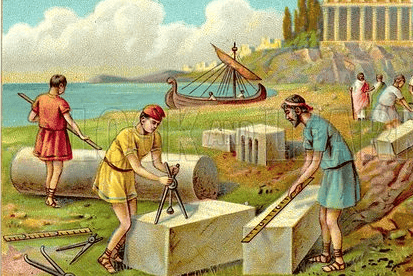
At the time the document was written all Freemasons were Operatives; that is, they were workers engaged on buildings. Such builders were then called ‘masons’. There were many kinds of masons, but the evidence indicates that those who were called ‘Freemasons’ were those of a superior type who designed, supervised and erected the great cathedrals and other marvellous structures in the Gothic style of architecture.
Where a number of Freemasons worked together on a building over a period of years, they organised a lodge which might meet in a temporary building, or in one of the rooms of an uncompleted structure. Such a lodge was governed by a Worshipful Master assisted by Wardens; it had a Secretary to keep its books, a Treasurer to keep and disburse its funds, a charity chest from which to dispense relief to members in accident, sickness or distress, and to widows or orphans of Master Masons. It met in regular communication, divided its membership into grades, admitted members by initiation — in short, it was in all essentials what a masonic lodge is today.
Training men for such work called for a long period of severe discipline. Boys sound in body, keen in mind, and of good reputation were taken at the age of ten or twelve, and apprenticed to some Master Mason for a number of years, usually seven. The Master Mason was such a boy’s father in Freemasonry, his tutor, his monitor and his guide, who taught him both the theories and practices of the Craft. The young beginner was called an Apprentice. After he was able to give evidence of his fitness, his name was entered on the lodge books, whereupon he was known as an Entered Apprentice. After his apprenticeship, he was called upon to prove his skill by producing what was called a ‘Master’s piece’ which, if acceptable, entitled him to become a full member of the Craft. Hence, in the sense that the word ‘fellow’ denotes ‘full’, a Fellow of the Craft. As at that time there were no more than two degrees, and he had now mastered his trade, he was called a Master Mason.
Having completed their work in one community these Freemasons would move to another, setting up their lodges wherever they went, while other types of masons were compelled to live and work in the same community under local restrictions. A number of historians believe it may have been because they were free of such restrictions that they were called ‘Freemasons’.
The Operative period of the fraternity flourished for generations. Then came a great change in its fortunes. Euclid’s geometry was re‑discovered and published, giving away many of the masons’ old trade secrets. The Reformation came and the Gothic style of architecture began to die out; social conditions underwent a revolution, laws were changed, and various factors brought about such a decline in the Craft that only a small lodge here and there clung to a precarious existence.
To recruit their numbers, the Freemasons adopted a new practice; they began to accept as members non‑Operatives who had no intention of becoming builders; usually enlightened gentlemen who, out of curiosity, for social reasons, or from interest in historical or ancient customs, became interested. And because they were thus accepted, they were called ‘Accepted Masons’. As time passed, their numbers increased until they overcame the Operatives in both numbers and influence.
As a result of this revolutionary step the Craft set out on a new path, and on St John the Baptist’s Day, 24th June, 1717, four old lodges of London and Westminster met in London and organised a Grand Lodge.
Within a few years the Craft had transformed itself from an Operative body into a Speculative Fraternity. By ‘speculative’ is meant Masonry in a moral or symbolical sense. The old two degrees were reorganised into the three degrees of Entered Apprentice, Fellowcraft and Master Mason. Lodges were chartered in many countries to accommodate the fraternity’s rapidly increasing membership. This was the beginning of organised Speculative Freemasonry as we now know it, and it must be clear that it did not spring full‑ formed out of nothing in 1717, but was a gradual development from the original builders of the Middle Ages.
Grand Lodges followed in Scotland, Ireland and on the Continent before a second one was formed in England. Early American Lodges — of which the earliest known was organised in Philadelphia in 1730, were placed under the charge of Provincial Grand Lodges of England, Scotland or Ireland.
Today we are builders too — except that where our forebears erected buildings, we try to build manhood. Their tools we have transformed into emblems of moral and spiritual values; their practices and secrets we have embodied in the Royal Art of Brotherly Love, Relief and Truth. Their rituals, mellowed, enriched and beautified with the passage of time, we employ in instructing our candidates and elevating them. All that was living and permanent we have preserved, and we use it on behalf of tolerance, goodwill, kindliness, charity and brotherhood among men. Such is our heritage, and as you enter into the spirit of it, you will discover it inexhaustible in interest and life‑long in its appeal; a power in your life to enrich, ennoble and inspire.
The Landmarks
Before the development of modern surveying, to establish the permanent boundaries of a property was a difficult and often perplexing problem. Almost the only method men could devise was to fix upon some feature, draw a line from it to another feature, thus establishing the limits of a property. It is, therefore, easy to understand why the destruction or removal of a ‘landmark’ was deemed so serious an offence!
Freemasonry has honoured this term as a name for one of the most important of its basic laws, namely, that there are certain principles, practices, traditions, usages and customs which cannot be changed by any Mason, lodge or Grand Lodge. Hence the term ‘Ancient Landmarks’. Freemasonry has an identity, a character of its own. Some things in it can be abolished, changed or modified without destroying that identity. These changes are acceptable because, after they have been made, Freemasonry continues as before! But there are other changes which, if made, would destroy Freemasonry itself. The Landmarks therefore signify that which is essential to the identity and integrity of Masonry, and whatever is found necessary to maintain and secure the perpetuity of Masonry has the property of a Landmark. Inevitably every Masonic authority varies in its assessment of them but, for the purpose of this exercise, we shall concern ourselves purely with those quoted by our source.
It is stated that Freemasonry began six or seven hundred years ago with the Operative Masons of Europe and Britain. Many of their arts, practices, customs, symbols and emblems became permanently embodied in the very nature of Masonry. If all that we inherited should be destroyed or abolished, not only would it destroy our connections with our history, but would, at the same time change our fraternity out of all recognition. Here is clearly something with the property of a Land mark.
Many things in Masonry are kept secret from the outside world. This secrecy is not a pose to gratify a desire for mystification, but is so essential to the very nature of the Craft that we could not even conceive of Masonry without it. Gone would be the ritual, the obligations, the modes of recognition, and all that homelike privacy which makes lodge so delightful. Secrecy also therefore has the property of a Landmark.
Ever since it began Masonry has admitted only adult men to membership. Each petitioner is required to possess certain qualifications, must be well recommended, of good character, free born, and of mature age. If these qualifications were removed, men of every sort would flock in; men not mentally or morally capable of living the Masonic life. The result would be no Masonry to live!
But it is not sufficient for a petitioner to be well qualified; he must also pass through the ceremony of initiation, which has been an integral part of the Craft from the very beginning. Eliminate initiation and it is possible that some sort of society would remain, but it would not be Freemasonry.
Another equally essential factor is the secret ballot. Because, since our principal purpose is to bring suitable men together into brotherly relations, it is absolutely necessary that such as are admitted do not disturb our harmony, but ensure its spread.
The ritual, with its assemblage of symbols, emblems, allegories and customs, is yet another factor belonging to the very essence of Freemasonry, and belongs so essentially to it, that without it the Craft would be devoid of light and warmth.
The sovereignty of Grand Lodge, the corresponding sovereignty of the lodge within its own jurisdiction, and the sovereignty of the unwritten law are a similar necessity. For without such sovereignty anarchy would ensue, and the fraternity would be battered to pieces by the discordant forces generated.
Every Mason must have respect for, and obedience to the civil law; no Mason may engage in feuds or rebellions; no political discussion can be brought into our assemblies. Were this abolished, our organisation would soon be taken captive by some political or social party, and would perish at the first turnover of political power.
To the same effect is the ancient law which forbids a candidate or brother being questioned as to his particular beliefs; also that no sectarian doctrine should intrude in a lodge. This constraint is utterly fundamental to the preservation of the Masonic concept of a universal brotherhood, expressed by the ideal of Brotherly Love. Without this discipline, the present harmony would be completely destroyed and fragmented into divergent and possibly conflicting factions, resulting in the ultimate destruction of the whole Masonic ethic.
What may be described as the crowning Landmark of all is the belief in God, belief in Immortality, belief in prayer! Here is the religious basis of Freemasonry — and when the word ‘basis’ is used, it is used in the literal sense. If the spiritual life were destroyed, our fraternity would — God forbid — degenerate into a mere social club!
You are not yet a Mason. When you are you will have the advantage of seeing it from the inside as well as from the outside. But at present this explanation is most important to you; it makes plain that Freemasonry is clearly conscious of what belongs to its proper nature. Against every possible influence it guards and cherishes that nature continually; a petitioner who comes into its membership must accept it as he finds it, for there is no way that Freemasonry may be changed to suit the petitioner! To become a Mason, therefore, you must be ready in all sincerity, to give whole‑hearted assent to its teachings and principles, obedience to its laws and regulations, and observance to its ancient Landmarks.
The Tenets
A tenet is a teaching so obviously true — so universally accepted — that we believe it without question, and always take it for granted. The principle tenets of Freemasonry are Brotherly Love, Relief and Truth. We consider them to be true in the sense that no man can question them. They are obvious, self‑proving, axiomatic!
Have you always considered them to be so? Is it not a common attitude for men to consider Brotherly Love, for example, to be highly desirable, yet hardly practicable? Is it not more of a vision, to be dreamed of but never possessed? Is it not a challenge for Freemasonry to call such things a ‘tenet’, for that means that they are not only true, but plainly and obviously and necessarily true! Until you grasp this fact, until you can see for yourself that our teachings are realities — and not visionary ideals — you may have difficulty in understanding Masonic teachings. For Freemasonry does not teach us that Brotherly Love, Relief and Truth ought to be true — that it would be better for all of us if they were true — it tells us that they are true! The question is not whether we shall believe in them or not, the question is what we are going to do about them?
Let us reflect upon the Principle Tenets beginning with Brotherly Love. Manifestly, it means that we place on another man the highest valuation as a friend, a companion, an associate and a neighbour. Life does not accord us too many opportunities of forming such friendships. It is enough merely to be with him, merely to spend time in his company, to have the privilege of working with him. This is all we ask! We should not expect that from our relationship we shall make money, or expect to further our business interests, or achieve some other form of gain. Our association with such a man is its own justification and its own reward. It is nevertheless true that the more devoted we are to worthy common causes — the more empathy develops between us — the more likely it is that, all things being equal, we will elect to deal with a brother Mason whose principles we acknowledge and share.
Brotherly Love is one of the supreme prizes, and Freemasonry builds on the fact that without it, life is lonely and unhappy. It provides unequalled opportunities for fellowship, encourages us to understand and practice it, which makes it one of the laws of our existence.
Relief, which stands next in the order, takes it for granted that any man — no matter‑ how industrious and cautious he may be — may, through some sudden misfortune or other conditions over which he has no control, find himself in temporary need of a helping hand. To extend help in such circumstances is one of the natural and inevitable acts of brotherhood which by its very nature, includes as apart of itself, this willingness to provide assistance.
Truth — the third of the Principal Tenets — demands something more than the search for truth in the intellectual sense. By Truth is meant that if we are to enjoy a permanent brotherhood, its members must be truthful in character and habit: dependable, men of honour as well as honesty; men on whom we can rely to be faithful and loyal friends. Surely no argument is needed to prove that Truth, as thus understood, is a necessity which we must consider as being beyond question!
Such are the Principal Tenets. You may not find any of them novel, or even particularly exciting. Novelty, however, while it may at times have its own interest, is not to be compared in value with the knowledge that the truths on which Freemasonry is founded are eternal. In them is a ceaseless inspiration and an inexhaustible appeal. They are the tenets of Freemasonry because always and everywhere, they have been the tenets of human life.
The Qualifications
The word ‘qualifications’ defines itself. It derives from a Latin term which means ‘value’. The Anglo‑Saxon term for the same idea was ‘worth’, from which we have ‘worthful’ and ‘worshipful’. Consequently, by a petitioner’s qualifications what is meant is the ‘worths’ or values he may possess to entitle him to fill a place in the fellowship of Masons.
These values are of two kinds, internal and external. The first ‘internal’ qualification is that the applicant must come ‘of his own free will and accord’, and the second, that he comes ‘uninfluenced by mercenary or other unworthy motive’. Clearly, then, he should not expect business, professional, or financial opportunities to emerge from his membership of the fraternity, but, by the same token, no member has the right to solicit such favours from him.
These qualifications are described as ‘internal’ because they derive from motives, and only an individual can know his own.
The external qualifications may, for the sake of convenience, be divided under four heads — the physical, mental, political and the moral. Under the physical, he must be of lawful age because no person can undertake Masonic obligations except when he has reached the age of discretion, and is legally responsible for his undertakings.
The mental qualifications are not expressly defined, but are clearly implied. Much is taught a Mason, and much is demanded of him. It is therefore reasonable to suppose that he must be required to possess a certain intellectual capacity to enable him to comprehend our system.
The political qualifications require that he be a free man; that he must be, in the true sense — his own master! Free to discharge his Masonic duties without interference. In addition, he must possess a sound reputation among those who know him best. Of even greater importance is that he be a good citizen, one who obeys the law; who is obedient — as the Ancient Charges express it — to the Civil Magistrate! He must be in all respects, one who supports the peace and good order of society.
The moral qualifications are that he should believe in God, in Immortality, and that the Volume of the Sacred Law — in our case the Holy Bible — should be the rule and guide of his faith. At the same time it is essential that he practice tolerance. He will not be asked the particular form or mode of his faith, nor should he seek to discover that of his brethren.
In this list of qualifications we have a portrait of the Mason drawn by the fraternity itself, and that portrait is official. So imperious is the fraternity’s moral requirement, that to think of a Mason as not devoted to integrity and rectitude of character is a contradiction in terms. How necessary it is that you grasp this fact in your endeavour to arrive at a true understanding of Freemasonry, it would be impossible to exaggerate!
And so — the prospective candidate being satisfied — to the petition itself. The applicant must sign it, and, supported by two members of the lodge, it will be presented at a regular meeting of the lodge. A month later, the details having been circulated to all other lodges in the District, a ballot will be taken. For the petitioner to be elected, the ballot — which elects for the first three degrees — must be favourable; whereupon an initiation fee will become payable.
You will see from all this, with a clearness beyond the possibility of misunderstanding, how the petitioner’s qualifications stand at the centre of the Craft, to qualify him to abide by our standards and recognise the goal of all Masonic endeavour.
It is not sufficient that a man should possess such qualifications for the mere purpose of petitioning for membership; they are permanently required of us all — as long as we remain members of the Craft!
Finally and above all, it must be said that Freemasonry will never demand anything which may conflict with your duty to your neighbour, to your country, to your family, or — indeed, to your God.