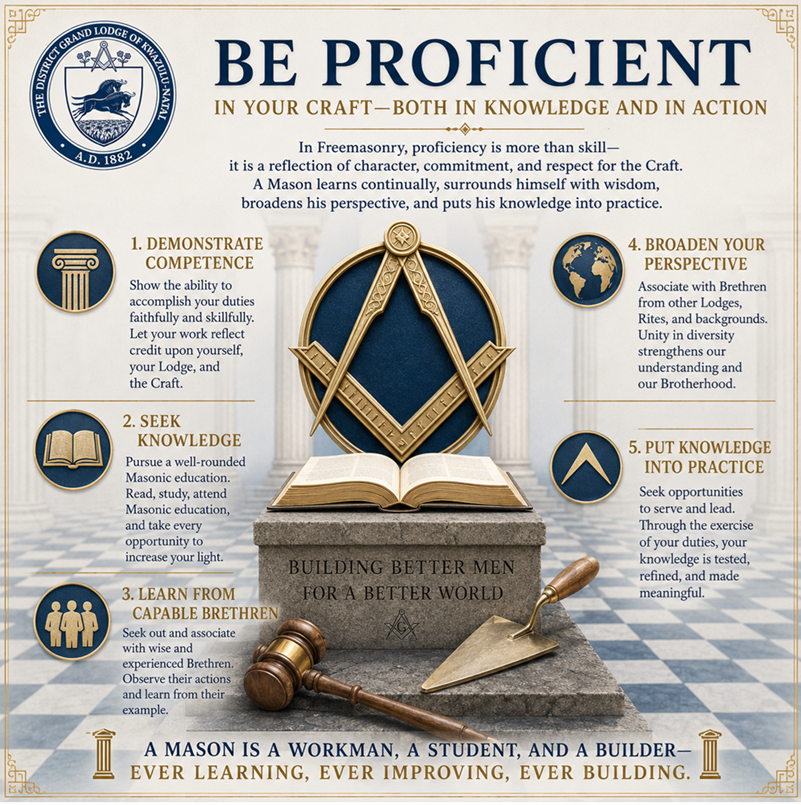
The phrase Be Proficient in Your Craft reminds every Mason that Freemasonry is more than outward skill. It is a way of building character, strengthening commitment, and showing respect for the lessons of the Craft.
A Mason should not only learn the words, signs, and ceremonies of Freemasonry. He should also understand their meaning and apply their lessons in daily life. True proficiency joins knowledge with action.
Therefore, a proficient Mason continues to learn, surrounds himself with wisdom, broadens his perspective, and puts his knowledge into practice.
Be Proficient in Your Craft: Demonstrating Competence
A Mason should strive to perform his duties faithfully and skilfully. Competence does not mean perfection. Rather, it means taking responsibility seriously and preparing properly for the work entrusted to him.
Whether he holds office, performs ritual, supports a candidate, or assists at a Lodge meeting, his effort should reflect care and respect.
For this reason, every Brother should aim to improve his ability. He should learn his work, understand his role, and carry out his duties in a way that brings credit upon himself, his Lodge, and the Craft.
When a Mason demonstrates competence, he strengthens the confidence of the Brethren. In addition, he supports the dignity and good order of the Lodge.
Seeking Knowledge
Freemasonry encourages every Brother to pursue knowledge. A Mason should not be satisfied with only knowing the surface of the ritual.
Instead, he should seek a deeper understanding of the principles, symbols, history, and moral lessons of the Craft.
This may involve reading, attending Masonic education sessions, listening to experienced Brethren, asking thoughtful questions, and reflecting on the ceremonies he has received.
In addition, a Brother should remember that Masonic knowledge grows over time. Each meeting, lecture, ceremony, and conversation can add something valuable to his understanding.
A Mason who seeks knowledge increases his light.
Learning From Capable Brethren
No Mason grows alone. A wise Brother learns from those who have walked the path before him.
He observes capable Brethren, listens to their guidance, and studies their example. Experienced Masons can teach much through their words. However, they often teach even more through their conduct.
Their patience, discipline, humility, and dedication show what Masonic proficiency should look like in practice.
Therefore, a Mason should associate with Brethren who encourage him to improve. He should seek out men of wisdom, integrity, and experience. Their example can help shape his own progress.
Good company strengthens good character.
Broadening Your Perspective
A Mason should also broaden his perspective. Freemasonry extends beyond one Lodge, one meeting, or one circle of friends.
By visiting other Lodges, meeting Brethren from different backgrounds, and learning from different Masonic experiences, a Brother gains a wider view of the Craft.
This does not weaken his loyalty to his own Lodge. Instead, it strengthens his appreciation for the larger Masonic family.
Furthermore, diversity of experience helps a Mason understand that unity does not require sameness. Brethren may come from different places, professions, cultures, and opinions. Yet, they can still meet in harmony.
A broader perspective deepens brotherhood.
Putting Knowledge Into Practice
Knowledge becomes meaningful when a Mason puts it into action. It is good to learn ritual, read Masonic literature, and understand symbolism. However, a Mason must also live the lessons he learns.
His conduct should show patience, honesty, charity, humility, and self-discipline.
For this reason, proficiency should never remain only in the mind. It should appear in behaviour.
A Mason tests and refines his knowledge through service. He serves his Lodge, supports his Brethren, assists candidates, contributes to charity, and carries the principles of Freemasonry into the world.
Through action, knowledge becomes wisdom.
Becoming a Workman
Freemasonry often describes a Mason as a workman. This reminds us that improvement requires labour.
A Mason must shape his character carefully, just as a craftsman shapes his material. He must remove roughness, correct faults, and build something worthy.
The tools of the Craft teach moral lessons. However, those lessons only become powerful when a Brother uses them.
Therefore, a Mason should examine himself regularly. He should ask whether his actions square with virtue, whether his words remain truthful, and whether his conduct benefits those around him.
A good workman does not merely admire the tools. He uses them.
Becoming a Student
A Mason should remain a lifelong student. No Brother should believe that he has learned all there is to learn.
The Craft contains lessons that unfold gradually through study, reflection, and experience. Even a familiar ceremony can reveal new meaning when approached with attention and humility.
Likewise, a conversation with a Brother may open a new path of thought.
For this reason, a proficient Mason keeps learning. He reads, listens, reflects, and grows.
The Mason who remains teachable continues to increase in wisdom.
Becoming a Builder
A Mason is also a builder. He builds character within himself, harmony within his Lodge, and goodwill within his community.
Through his conduct, he helps build a better Lodge and a better world.
This work does not always require grand gestures. Often, it begins with small acts of duty: attending regularly, preparing properly, speaking kindly, helping quietly, and keeping promises.
In addition, a Mason builds by encouraging others. He supports newer Brethren, respects older Brethren, and contributes to the unity of the Lodge.
Every faithful action adds another stone to the building.
Ever Learning, Ever Improving, Ever Building
Proficiency in Freemasonry is not a single achievement. Rather, it is a lifelong habit.
A Mason should always learn more, improve himself, and build with purpose. His progress should show in his work, his speech, his relationships, and his service.
Therefore, proficiency is not only about what a Mason knows. It is also about what he does with that knowledge.
A proficient Mason becomes more useful to his Lodge, more supportive of his Brethren, and more faithful to the principles of the Craft.
Conclusion
To Be Proficient in Your Craft is to combine knowledge with action. A Mason demonstrates competence, seeks knowledge, learns from capable Brethren, broadens his perspective, and puts his lessons into practice.
Yet, above all, he continues the work of self-improvement. He is a workman, a student, and a builder.
Through continual learning, honest effort, and faithful service, he strengthens himself, supports his Lodge, and helps build better men for a better world.
This is the true lesson of Be Proficient in Your Craft: learn with humility, work with purpose, and build with honour.