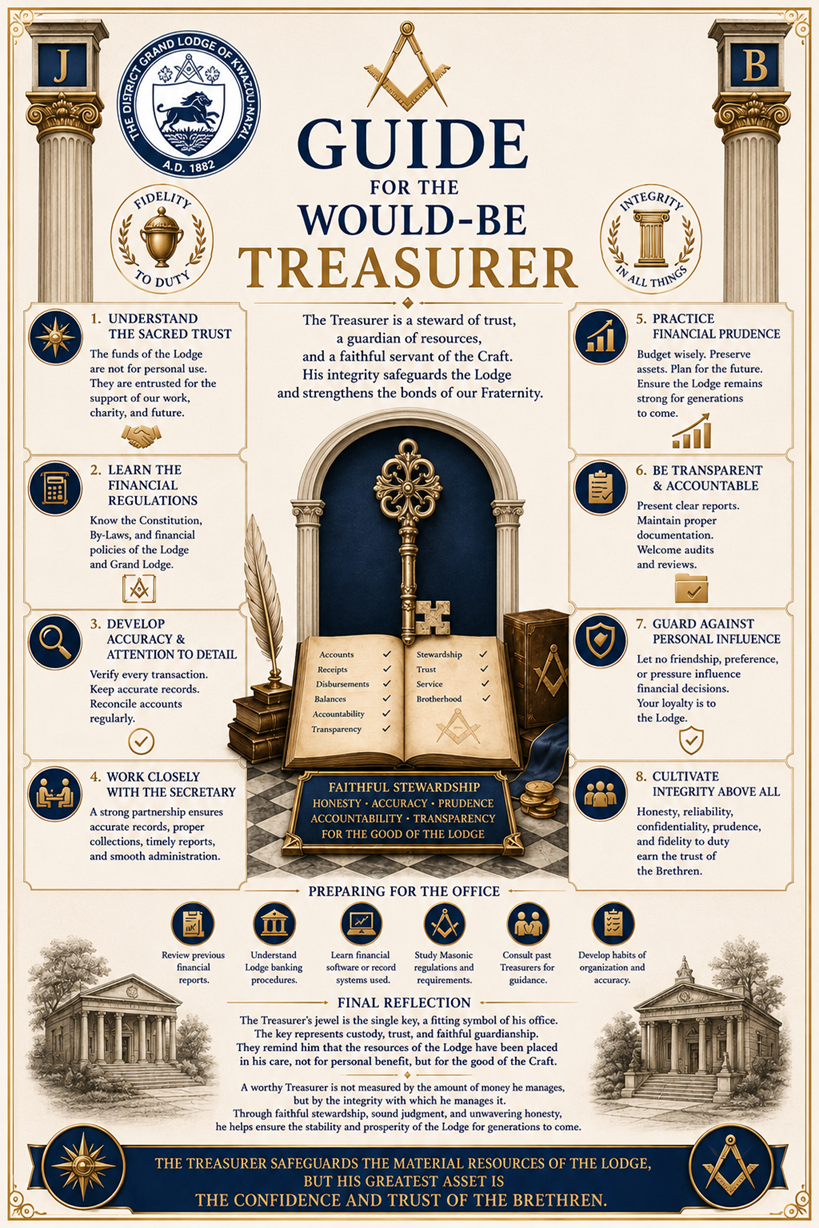
The Guide for the Next Treasurer is written for the Brother who may one day hold one of the most trusted offices in the Lodge. The Treasurer protects the material resources of the Lodge and helps preserve its financial stability. While some offices appear more visible in ritual or ceremony, the Treasurer often serves quietly in the background.
His work may involve accounts, records, payments, collections, subscriptions, reports, and financial planning. However, the office is not only about money. It is also about integrity, accuracy, responsibility, and faithful stewardship.
Therefore, a Brother who hopes to become Treasurer should understand the dignity of the office. He will not simply manage funds. Instead, he will become a guardian of trust, a servant of the Lodge, and a steward of resources placed in his care for the good of the Craft.
Guide for the Next Treasurer: Understanding the Sacred Trust
The funds of the Lodge do not belong to the Treasurer. They are not for personal use, personal convenience, or private advantage.
Rather, they belong to the Lodge and support its work, charity, administration, fellowship, and future. For this reason, the Treasurer must treat every financial matter with care and respect.
Every receipt, payment, balance, and report deserves careful attention. A faithful Treasurer remembers that the Brethren have placed confidence in him. Therefore, he must protect that confidence through honesty, accuracy, and sound judgement.
A Lodge can recover from many small difficulties. However, lost trust takes much longer to restore. As a result, the Treasurer should guard trust as carefully as he guards the funds themselves.
Learning the Financial Regulations
A Treasurer should understand the financial regulations that govern the Lodge. These may include the Book of Constitutions, Lodge by-laws, District or Provincial requirements, Grand Lodge rules, banking procedures, and local financial policies.
He does not need to know everything on his first day. However, he must show willingness to learn, ask questions, and seek guidance from experienced Brethren.
In addition, he should understand how the Lodge handles subscriptions, dining fees, charitable collections, invoices, reimbursements, bank accounts, reports, and audits. Good financial management begins with knowledge.
By learning the rules early, the Treasurer protects both himself and the Lodge. He also helps the Brethren feel confident that the Lodge finances remain in good order.
Developing Accuracy and Attention to Detail
Accuracy is one of the most important qualities of a good Treasurer. Every transaction matters.
A small error, if ignored, can become a larger problem later. Therefore, the Treasurer should verify payments, keep clear records, reconcile accounts regularly, and retain proper documentation.
He should also avoid delaying financial work. When records remain current, the Lodge stays informed and confident.
Furthermore, accurate accounts help the Worshipful Master, Secretary, Committee, and Brethren make better decisions. In this way, a careful Treasurer prevents confusion before it begins.
Working Closely With the Secretary
The Treasurer and Secretary should work in close partnership. Each office has its own duties, yet both support the proper administration of the Lodge.
The Secretary often handles correspondence, summonses, records, and communication. Meanwhile, the Treasurer manages the financial side of the Lodge.
However, their duties often overlap in practical ways. Subscriptions, arrears, dining payments, donations, resignations, joining members, and member changes may affect both offices.
For this reason, regular communication between the Secretary and Treasurer helps keep records accurate and administration smooth. A strong working relationship between these two officers strengthens the whole Lodge.
Practising Financial Prudence
A Treasurer must practise financial prudence at all times. This means budgeting wisely, preserving assets, planning for future expenses, and helping the Lodge remain financially stable.
He should not allow short-term convenience to damage long-term security. In the same way, he should not encourage unnecessary spending simply because funds are available.
Instead, the Treasurer should help the Lodge think carefully about its needs, obligations, and future responsibilities. Financial prudence protects the Lodge for years to come.
Therefore, the next Treasurer should learn to balance generosity with caution. A Lodge should support good work, but it must also protect its future.
Being Transparent and Accountable
Transparency builds trust. For this reason, the Treasurer should present clear reports to the Lodge and explain figures when necessary.
He should also make sure that the Brethren understand the financial position of the Lodge. Clear reporting prevents confusion and helps members make wise decisions.
In addition, he should maintain proper documentation for payments, receipts, bank statements, invoices, approvals, and financial decisions.
A good Treasurer welcomes audits, reviews, and questions asked in the proper manner. These checks do not insult his integrity. Rather, they protect both the Treasurer and the Lodge.
Guarding Against Personal Influence
The Treasurer must make financial decisions with fairness and independence. He should not allow friendship, preference, pressure, or personal opinion to influence the handling of Lodge funds.
His loyalty must remain with the Lodge and its proper rules. Therefore, he should avoid informal arrangements that may later cause confusion.
He should also make sure that payments and financial decisions follow the correct procedures. This protects the Lodge and prevents misunderstanding.
A good Treasurer treats every Brother fairly and applies the same standard to all. In this way, integrity becomes visible through consistency.
Cultivating Integrity Above All
A Treasurer may have good financial skills, but without integrity those skills lose their value. Honesty, reliability, confidentiality, prudence, and fidelity to duty are essential qualities for the office.
The Brethren must know that their Treasurer can be trusted with both money and information. Sometimes, financial matters may involve personal circumstances, arrears, hardship, or sensitive discussions.
Therefore, the Treasurer must handle such matters with discretion and kindness. The true measure of a Treasurer is not only found in the accounts he keeps. Rather, it is found in the confidence he earns.
Preparing for the Office
A Brother who may one day serve as Treasurer should begin preparing early. He can review previous financial reports, learn the Lodge banking procedures, and understand the record systems used by the Lodge.
In addition, he should study the regulations that apply to Lodge finances. He should also speak with past Treasurers and ask for practical guidance.
Their experience can help him avoid common mistakes and understand the rhythm of the office. Good preparation reduces pressure and builds confidence.
As a result, the Treasurer who prepares before taking office serves the Lodge better from the start.
The Treasurer’s Jewel
The Treasurer’s jewel in English Freemasonry is a single key, usually appended to the collar of his office.
This key is a fitting symbol of his duty. It represents custody, trust, and faithful guardianship. It also reminds the Treasurer that the resources of the Lodge have been placed in his care for the good of the Craft.
This symbolism should guide his conduct. A Treasurer must guard the Lodge’s resources carefully, open only what should be opened, keep secure what must remain protected, and act with wisdom and responsibility.
Therefore, the key is more than a badge of office. It is a reminder of the trust that every Treasurer must honour.
Final Reflection
A worthy Treasurer is not measured by the amount of money he manages. Instead, he is measured by the integrity with which he manages it.
Through faithful stewardship, sound judgement, and unwavering honesty, he helps ensure the stability and prosperity of the Lodge for years to come.
His work may not always receive public praise. Nevertheless, it forms part of the foundation on which the Lodge depends.
Therefore, the Treasurer safeguards the material resources of the Lodge, but his greatest asset remains the confidence and trust of the Brethren.
Conclusion
The office of Treasurer forms a vital part of a healthy and well-governed Lodge. He protects the funds, maintains accurate records, supports clear administration, advises with prudence, and preserves the trust placed in him by the Brethren.
Yet, above all, the Treasurer serves. He serves through honesty, accuracy, discipline, confidentiality, and quiet dedication.
A good Treasurer does not merely manage money. He safeguards trust, strengthens the Lodge, and helps preserve its future.
This is the true lesson of the Guide for the Next Treasurer: trust carefully held, records faithfully kept, and service quietly given.